Capturing the spirit of South Dakota in every gift!


Your cart is currently empty
Product image slideshow Items
Available in store
CloseOne of our generation’s most important literary voices, Esther G. Belin was raised in the Los Angeles area as part of the legacy following the federally run Indian relocation policy. Her parents completed the Special Navajo Five-Year Program that operated from 1946 to 1961 at Sherman Institute in Riverside, California. Drawing from this experience, her poetry, activism, and multimedia work speaks to larger issues of urban Indian identity, acceptance, adaptation, and cultural estrangement.
In this long-anticipated collection, Belin daringly maps the poetics of womanhood, the body, institution, family, and love. Depicting the personal and the political, Of Cartography is an exploration of identity through language. With poems ranging from prose to typographic and linguistic illustrations, this distinctive collection pushes the boundaries of traditional poetic form.
Marking territory and position according to the Diné cardinal points, Of Cartography demands much from the reader, gives meaning to abstraction, and demonstrates the challenges of identity politics.
About the author: Ester G. Belin is an artist and poet. Her latest work is a personal study of abstract realism and a flesh-burdened reality. Belin graduat4ed from the University of California at Berkley, the Institute of American Indian Arts in Santa Fe, New Mexico, and Antioch University in Los Angeles. In 2000, she won the American Book Award for her first book of poetry, From the Belly of My Beauty. Belin is a citizen of the Dine nation, which is enveloped inside the southwestern United States. She lives on the Colorado side of the four corners.
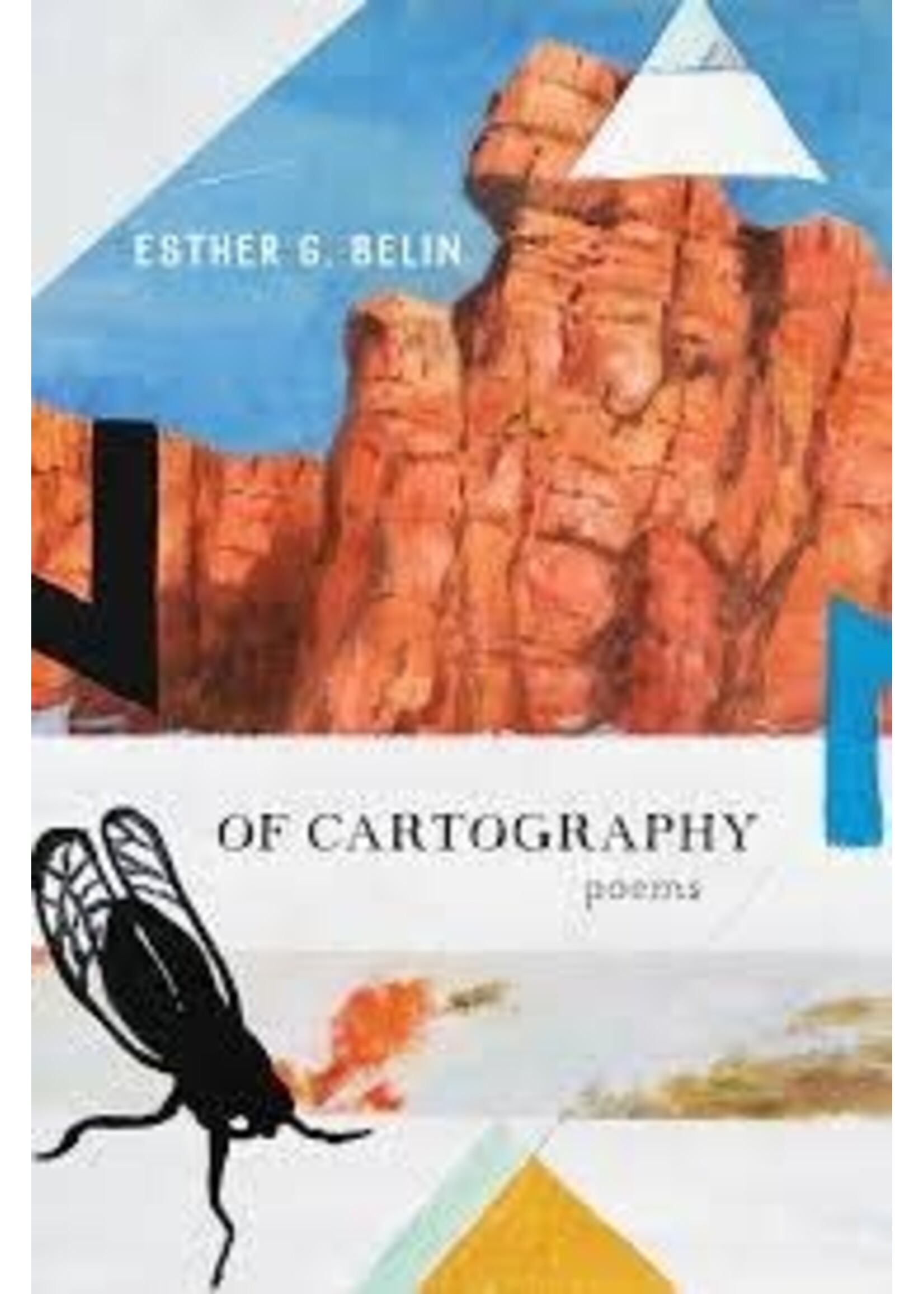
Image description: The illustration on the cover has a dynamic composition. On the upper half, there is a depiction of a mountainous landscape. The mountain is rendered in shades of orange and red. In contrast to the warm tones of th4e mountain, there is a cool blue sky above. On the left side of the bottom half there is a bold silhouette of a fly. The author's name is printed in white letters in the sky, and the title is printed in black letters, in a white background right beneath the mountains.